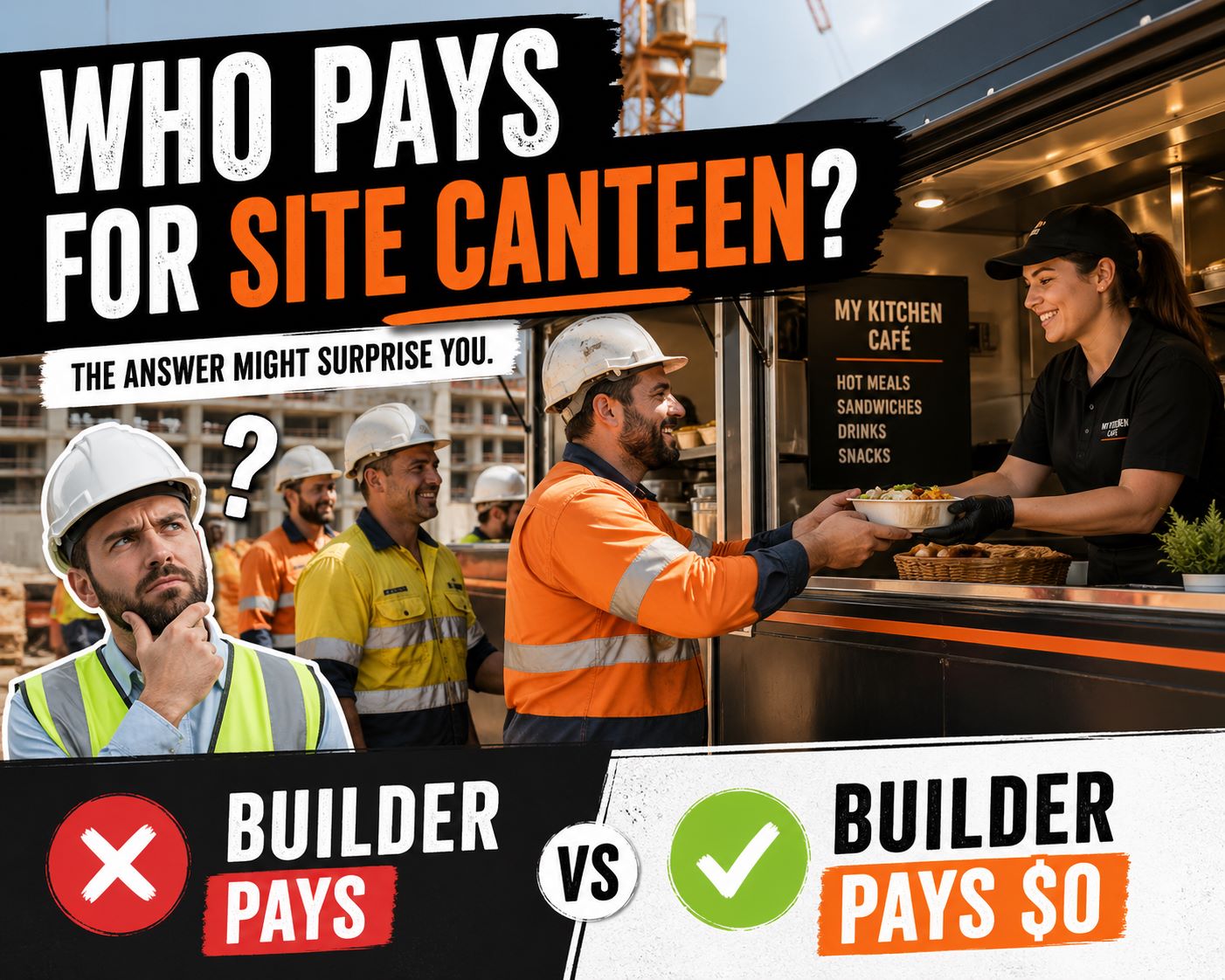
It's one of the first questions a project manager asks when the topic of site catering comes up — and the answer is less obvious than most people expect. Understanding who actually pays, and how, changes the entire procurement conversation.
MyKitchen Café — Site Operations
Who Pays for the Canteen on a Construction Site?
7 min read
·
Site Operations
·
Published by MyKitchen Café
It's one of the first questions a project manager asks when the topic of site catering comes up — and the answer is less obvious than most people expect. Understanding who actually pays, and how, changes the entire procurement conversation.
On most NSW construction sites, the answer to "who pays for the canteen" depends entirely on how the catering arrangement has been structured. There are fundamentally two models in use, and they have very different cost and management implications for the builder.
Getting this wrong — or defaulting to the more expensive model out of habit — costs builders money they don't need to spend and creates contract management obligations they don't need to carry.
The Two Models, Side by Side
At its simplest, the question of who pays for the canteen comes down to whether the builder is treating catering as a contracted service or a commercial concession.
Model A
Builder Pays — Catering as a Contracted Service
The builder contracts a catering company, pays a weekly or monthly fee, and the caterer provides the service. Workers may pay for individual meals, but the operational cost sits with the builder regardless of volume.
Builder carries the cost
Model B — Industry Best Practice
Caterer Operates Commercially — Zero Cost to Builder
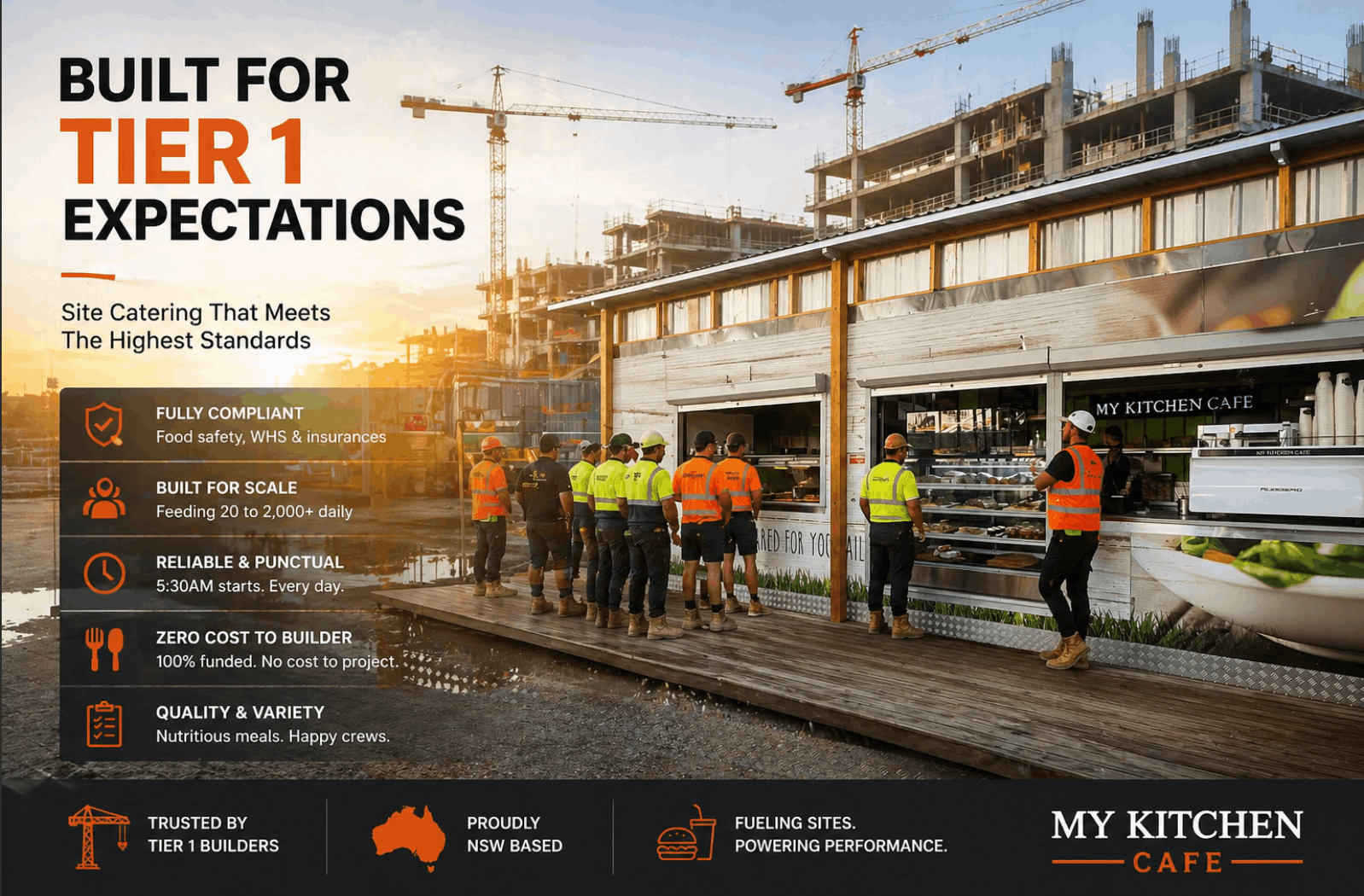
The builder provides the space and access. The caterer funds and operates the canteen as their own commercial venture, generating revenue through daily worker purchases and vending. No invoice to the builder.
Builder pays nothing
Model B — the zero-cost-to-builder arrangement — is how well-structured site catering should work on projects with sufficient workforce volume to support it. It's not a new concept, but it remains poorly understood outside the industry, and many builders default to Model A simply because that's what they've always done.
How the Zero-Cost Model Actually Works
The mechanics are straightforward. A capable catering operator runs the site canteen the same way a café owner runs a café — as a business. Revenue comes from what workers spend at the counter each day: breakfast, lunch, snacks, drinks. On a site with a healthy workforce headcount, this is a commercially viable operation.
Where the Revenue Comes From — Zero-Cost Model
01
Daily worker spend — breakfast and lunch purchases from workers on site each day. On a site of 200+ workers operating six days a week, this is a substantial and predictable revenue base.
02
Vending machine commissions — where the caterer installs and operates vending machines, commission revenue runs 24/7, including outside canteen hours. The builder pays nothing for the machines.
03
Event and milestone catering — top-outs, slab pours, client visit catering, and safety milestone events are priced and invoiced separately. These are the exception, not the ongoing cost.
04
The builder's contribution — space, power, water access, and site induction. No fees. No weekly invoices. No contract management beyond the initial agreement.
The caterer takes on the commercial risk. If the site is slow, the caterer wears it. If the site ramps up, the caterer benefits. The builder is insulated from that variability entirely.
What Determines Which Model Applies
The zero-cost model isn't available on every project. It depends on whether the workforce volume is sufficient to support a commercially viable canteen operation. A site with 30 workers cannot generate the daily throughput a caterer needs to cover their staffing, food, and equipment costs without charging the builder.
The threshold isn't fixed — it depends on the caterer's cost structure. But as a rough guide, sites with 100 or more workers operating consistently are typically well within range.
Below that threshold, some cost contribution from the builder is usually necessary. Above it, a well-run caterer should be able to operate on commercial terms — and if they can't, that tells you something about how lean their operation actually is.
The other variable is duration. A two-week fit-out doesn't support the same arrangement as an 18-month construction programme. The zero-cost model works best on projects with a stable, multi-month operational window where the caterer has time to build a reliable daily trade.
Common Misconceptions — Cleared Up
| What People Assume |
What's Actually True |
| "The builder always pays for the canteen" |
✗ On well-structured projects with adequate workforce numbers, the builder pays nothing for daily canteen operations. |
| "Zero-cost means lower quality food" |
✗ The caterer's commercial incentive is the opposite — happy workers spend more and come back every day. Quality is in their interest, not yours. |
| "Workers pay more under this model" |
✗ Pricing needs to be competitive to drive volume. An overpriced canteen loses trade to packed lunches. Pricing is market-constrained. |
| "The builder has less control over the canteen" |
✗ Standards, dietary coverage, operating hours, and hygiene requirements are set in the agreement. The caterer is commercially motivated to meet them. |
| "Only small operators do zero-cost arrangements" |
✗ Experienced construction site caterers build their entire model around this arrangement. It's a marker of operational maturity, not desperation. |
What This Means for Procurement
If you're a project manager or contracts manager putting together a site services package, the canteen question shouldn't be defaulted — it should be evaluated. The right questions to ask a prospective caterer:
Questions to Ask Before You Sign Anything
- At what workforce size does your zero-cost model become viable? Be specific.
- What does the builder provide, and what do you bring? List it out.
- What happens if the workforce drops significantly mid-project — is there a threshold where costs shift?
- How are milestone and event catering priced? Separately or bundled?
- What's your track record running this model on comparable projects in NSW?
A caterer who can't answer these questions clearly — or who defaults immediately to a fee-based model without exploring whether zero-cost applies — hasn't structured their operation to serve the construction industry specifically. They've adapted a hospitality model and applied it to sites.
The Hidden Cost of Getting This Wrong
Choosing the wrong catering model doesn't just show up as a line item on the project budget. It shows up in other ways.
A builder paying for a contracted catering service now has an invoice to process every week or month. They have a service fee that continues regardless of whether the canteen is hitting utilisation targets. They have a caterer who is commercially insulated from performance — because they get paid either way.
Under the zero-cost model, the caterer's income depends entirely on the quality and consistency of their service. They have skin in the game every single day. That commercial alignment is, in practice, a more reliable quality driver than any service-level clause in a catering contract.
The second hidden cost is procurement overhead. A catering contract that involves regular invoicing, cost reviews, and budget reconciliation consumes project management time. On a large project running tight schedules, that time has real value. Eliminating the canteen as a budget line item eliminates it as a management item too.
The Short Answer
On a well-run NSW construction site with adequate workforce numbers, the builder shouldn't be paying for the canteen at all. The workers fund it through their daily spend. The caterer runs it as a business. The builder provides the space and walks away from the cost.
If your current or upcoming project is paying a catering fee — and your workforce headcount would support a commercial canteen operation — it's worth asking whether you're in the right model.
MyKitchen Café operates on a zero-cost-to-builder model on qualifying NSW construction sites. Talk to us about whether your project fits.
Get in Touch →
Site Operations
Construction Catering
NSW
Canteen Costs
← All Posts