Industry Insights
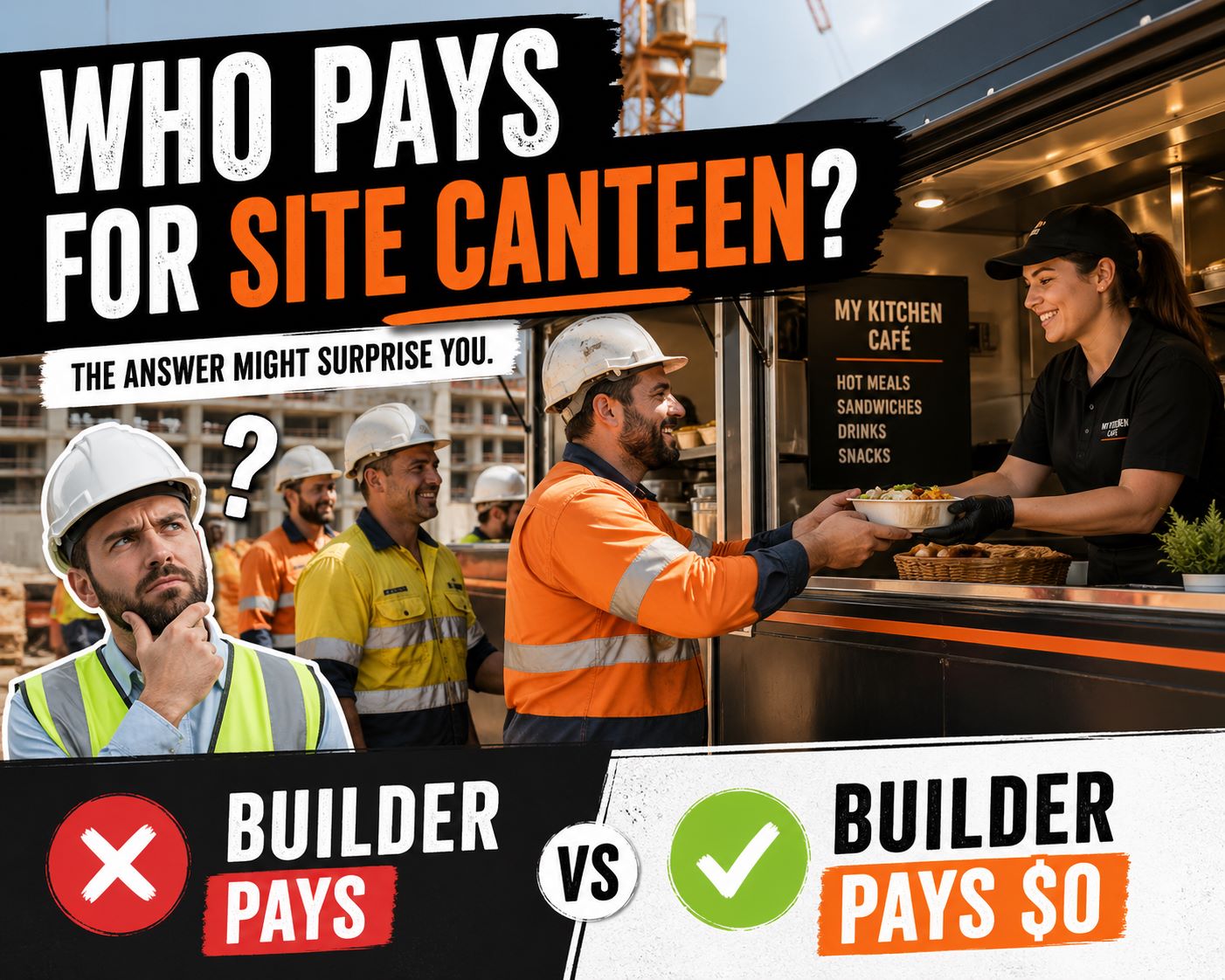
Who Pays for the Canteen on a Construction Site?
It's one of the first questions a project manager asks when the topic of site catering comes up — an...
If you're a project manager or contracts manager on a large NSW construction site, you already know that catering is not a hospitality decision. It's a procurement decision — with WHS, compliance, and operational consequences if you get it wrong.
MyKitchen Café — Site Operations
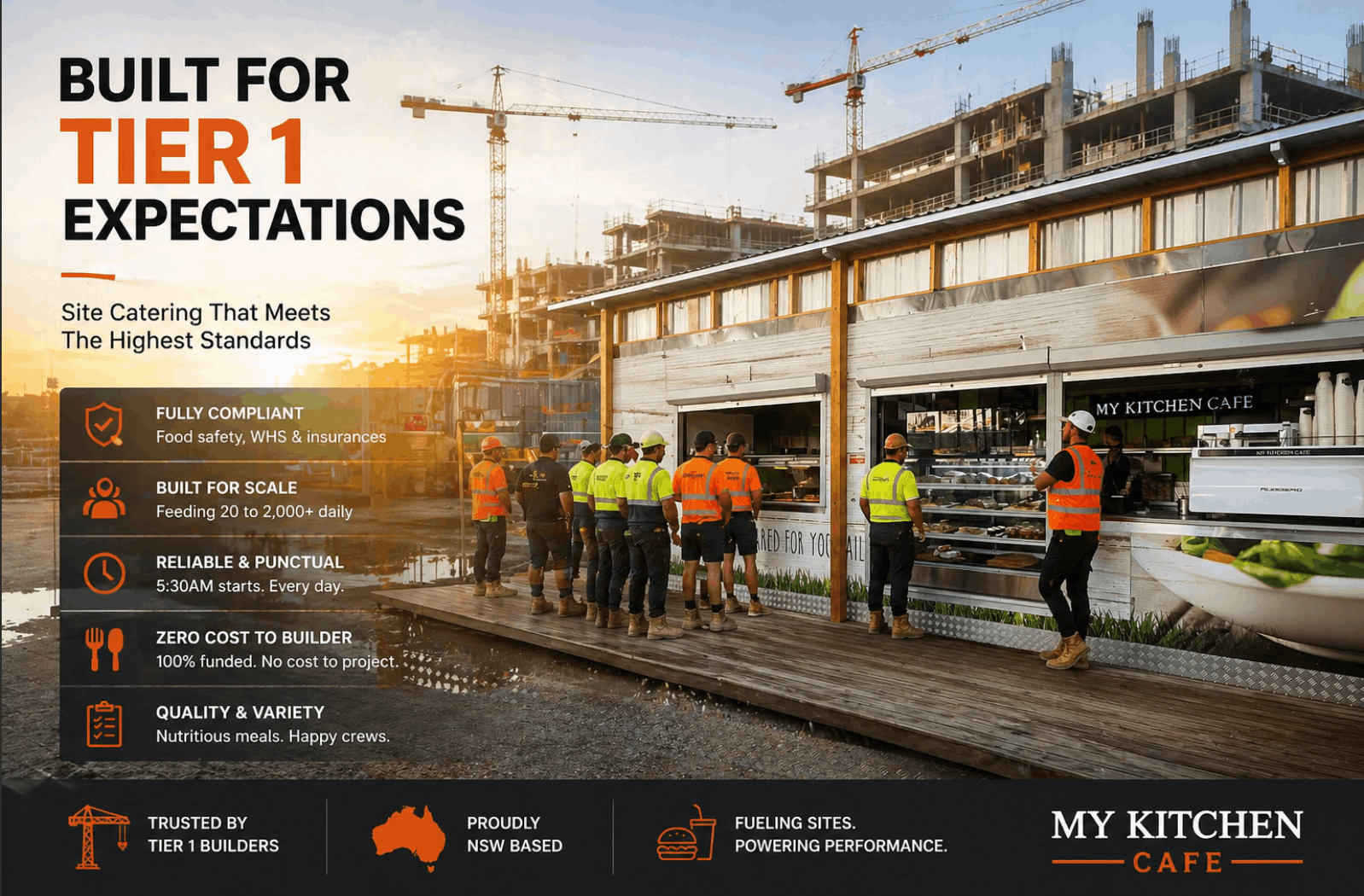
Tier 1 construction projects in NSW — the hospitals, airports, transit corridors, and high-rise towers that define the state's infrastructure pipeline — run to demanding standards. Every subcontractor and service provider on site is evaluated against those standards, and site catering is no exception.
The problem is that most caterers don't know this. They pitch food. Tier 1 procurement managers are buying something else entirely.
This post breaks down what actually gets a catering provider approved — and what gets them knocked out — when they're trying to service a major construction project in NSW.
Before a caterer puts a single item of food on a Tier 1 site, they need to pass procurement's documentation check. This isn't a formality — it's a hard gate. Missing or expired paperwork means no access, regardless of how good the food is or how long the relationship has existed.
The baseline requirements a serious site caterer should have ready at all times:
A caterer who can't produce these documents within 24 hours of being asked has already failed the Tier 1 test — whether or not they realise it.
Tier 1 sites in NSW operate diverse workforces. A single canteen on a major project might serve workers from dozens of cultural and religious backgrounds, alongside tradies with common dietary preferences and site managers with their own requirements.
Catering providers who can only cover "standard" menus create both operational and cultural friction. The minimum coverage expectation on most significant sites:
| Dietary Requirement | Why It Matters on Site |
|---|---|
| Halal | Required for a significant proportion of the NSW construction workforce; absence creates exclusion and WHS/equity concerns |
| Vegetarian | Growing proportion of the workforce; also serves as the baseline for many other dietary restrictions |
| Vegan | Increasingly expected; difficult to retrofit if not designed into the menu from the start |
| Gluten-aware options | Medical necessity for some workers; important to flag clearly rather than leave workers to guess |
| High-protein, high-energy options | Physical labour demands — workers need adequate fuel to perform and to stay safe |
The operational implication: dietary coverage can't be an afterthought or a special-order arrangement. It needs to be built into the standard daily menu rotation so that every worker can eat a complete meal without flagging their requirements or waiting separately.
Construction sites don't operate on café hours. Major NSW projects typically run from first light, with workers on site well before 7am. The canteen needs to match that rhythm — not approximate it.
A caterer who can't open at 5:30am is not a fit for a Tier 1 site. That's not a preference — it's an operational requirement.
Six-day operating weeks are standard on active projects. Public holidays may or may not apply depending on the project programme and the principal's requirements. A catering provider needs to be contractually and operationally committed to these hours — not flexible about them.
Reliability is the key word here. One missed service window on a large site affects hundreds of workers, creates industrial friction, and reflects directly on the site manager responsible for the canteen contract.
Tier 1 projects don't stay the same size. The workforce on a major hospital build or airport terminal can move from 200 workers to 800 workers over the course of a programme, then ramp down again. A caterer who can service 300 workers on Tuesday needs a credible answer for how they'll handle 700 workers on the day of a large subcontractor mobilisation.
Procurement managers and site managers evaluate this during the selection process, not after a problem occurs. Expect questions like:
A caterer who can only articulate what they do on a normal day — not what they do when things aren't normal — is not ready for a Tier 1 environment.
This is where most people outside the industry are surprised. On well-structured projects, the builder doesn't pay for the canteen.
The zero-cost-to-builder model works because a capable catering operator runs the canteen as a commercial venture — generating revenue through daily worker spend and, where applicable, vending machine commissions — rather than billing the builder for a service. The builder provides the space and access. The caterer provides everything else.
For a Tier 1 builder's procurement team, this model eliminates a budget line and a contract management obligation. The canteen becomes a worker amenity that costs the project nothing and generates no invoices to process.
Not every caterer can operate this way. It requires genuine commercial confidence in the operation — the volume needs to support the model. But for projects with 100+ workers, it is achievable, and procurement teams on major projects increasingly expect it as the standard rather than an exception.
Tier 1 builders run structured milestone programmes — slab pours, top-outs, safety milestones, client and consultant site visits. These events require catering at short notice, at a different quality register to daily canteen service, and often in locations on site that aren't the canteen itself.
A site caterer who can handle milestone events removes a significant coordination burden from the site management team. The alternative — sourcing a separate catering company for events while maintaining a canteen caterer for daily service — creates two vendor relationships, two sets of inductions, and two points of failure.
Practical capability here means: equipment that can be moved around site, the ability to serve food in open areas or temporary structures, and a menu that works for both a tradie breakfast and a client function.
Tier 1 builders manage risk carefully. A site manager recommending a new catering provider to a project director or a principal contractor needs to be confident that the recommendation won't create a problem six months in.
The practical implication is that catering providers without a documented track record on major construction sites face a significant credibility gap. Reference letters from recognised builders, named projects, and verifiable service periods are the minimum standard. The ability to name the site manager or Employee Relations manager who can speak to the experience is more valuable still.
Smaller projects and residential sites are not the same operating environment. They don't count as references for Tier 1 work in the way the industry evaluates experience.
If you're a project manager or contracts manager running a procurement process for site catering on a major NSW project, the shortlist criteria are reasonably straightforward. The caterer needs to demonstrate:
If a caterer can't demonstrate all of these, they're not ready for the environment — regardless of how good the food is.
MyKitchen Café has been servicing major NSW construction sites since 2012 — including Tier 1 projects across Greater Sydney, Western NSW, and the Hunter region.
Talk to Us About Your Site →
It's one of the first questions a project manager asks when the topic of site catering comes up — an...